One of the top questions or concerns I get when people book their holidays in Italy is about traffic and driving in Europe. Many people have heard of the Autostrada – the speeds, the fancy cars, and crazy European drivers – and are intimidated by the thought of having to do it themselves.
I’ve even heard many clients tell me that they will only take trains or buses as they did not even consider driving in Italy as an option given their fears. This would be a HUGE mistake as not only would you be missing out on views you would not otherwise see, but also, you’d be missing out on some of the most unique adventures that you can have that you otherwise would not enjoy if you only used public transportation.
These are my top three tips for driving on the Italian highways:
Limited Traffic
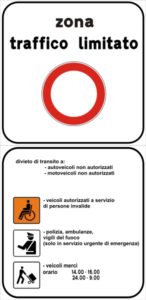
City centers are often closed off from traffic for environmental reasons. And those that are not usually have ZTL signs. That means area (zona) has limited (limitato) traffic (traffico) which means you need a pass to permit. Most GPS systems will tell you that.
limited transit city sign
In some cases only certain streets are viable and a wrong turn will net you a photograph and a fine. So for instance, Google ZTL Firenze and see the times, locations and parking that is available if you choose to go to Florence by car.
Gas Stations not Always Open
Gas stations are run just like any other business in Italy. They are mostly closed for lunch from about 12:30-3pm or 3:30pm. They are not open on Sundays or holidays. So make sure your car is filled on Saturday for instance. Automated 24 hour stations are available but make sure you have a 4 digit pin card (whether it’s a debit card or credit card). Cash is not a problem. You will need to spend some time figuring out the pump at the automated one, and English translation is not always available. The best bet is to go to one when it’s open and fill up there. Usually an attendant will fill it up for you. On the autostrada, stations are always open. Here, fuel can be more expensive and prices do very from city to city.
Rent a Car… But Be Wise
Visiting Italy by car is by far the best way to see the country. The one great thing about renting vehicles in Italy is that you can drop the car off in any other city within Italy and not have to pay a drop-off fee. In Italy, all rentals come with CDW coverage so you can’t take advantage of your credit card to cover that cost. Airport pick-ups have extra fees, so the best way to save some money is to figure out when you need the car and rent accordingly. For instance, you arrive in Rome Fiumicino airport and your plan is to spend four days in Rome and then head to the Amalfi coast for four more days.. Take a shuttle, a cab or Uber to your hotel in Rome. Rome is best enjoyed by foot and a car would only be an expensive inconvenience.
Use Train as Alternative
Train stations are always in the downtown of the cities therefore on your forth day you can take the train to Sorrento and pick up the car there. You need a car for the windy Amalfi coast and the surroundings such as Pompei, Ercolano or Salerno. Using public transportation here would only add lots of time and extra expenses as well you would not be able to enjoy those sights at your own pace.
The savings are substantial. Just parking in Rome alone for four days could cost you €150. Unless there are four or six of you, the train to Sorrento is way cheaper than tolls, gas and time spent trying to get out the congested Italian capital. Since you are also renting the car in the city and not at an airport, you will be spared the extra airport tax that all rentals have. There is no tax if you drop off the car at an airport.
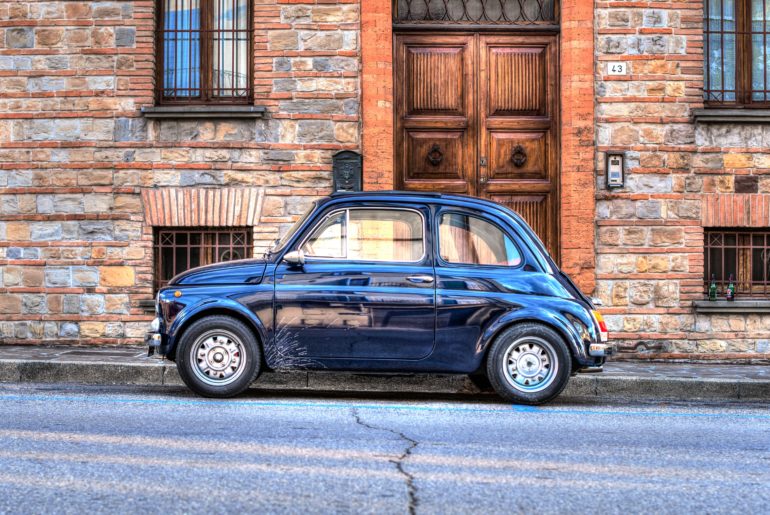
Unless you are renting a compact car most cars are diesel (gasolio). If you do have a choice, get a diesel car. The fuel is about 20-30% cheaper than gas and the mileage is much better. With my last car, I averaged about 5,5L per 100km or 43MPG. And at € 1.40 per litre, you would want good mileage
Check out my other post on the Italian autostrada ( freeways ) for more insights on driving in Italy.
“Till then…Buon viaggio.
Are you travelling to Italy and are interested in my assistance, or would like to comment on my post? Just drop a line below or contact me privately at info@italiabound.com.
‘I hear you are going to Italy this summer…. will you be driving there?”
“No way! They are crazy drivers over there.”
Not Really Crazy Drivers
It’s certainly fair to say that Italians don’t drive defensively, but to say they are crazy drivers is certainly overkill.
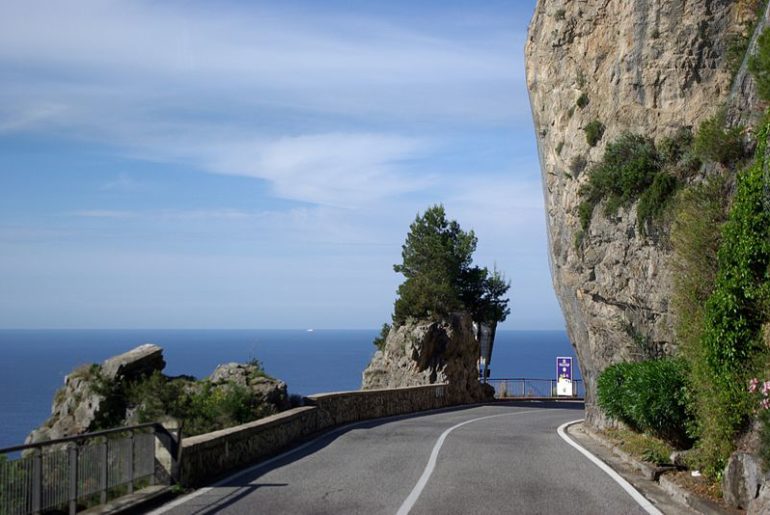
Not all Italian drivers are aspiring Formula One drivers and you will find all sorts just like anywhere else in the world. I think what makes tourists a bit squeamish about driving there, is that it isn’t so much the drivers on the road, but the roads themselves and the country’s landscape. Italy can put a road where only Italians can see it fit.
Driving in the country, you’ll notice beautiful landscapes, but paying attention to the roads is a must, as often they serpentine through fields of poppies or lavender while climbing to small towns that don’t even seem to have roads- just very narrow mulattiere (old mule trails that are now paved).
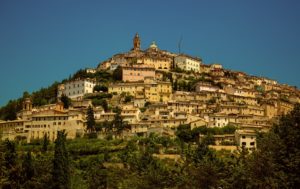
Medieval town on top of rocky slope. Are there roads there?
Towns that from a distance look as if they sit on top of a rock somehow have narrow streets that fit and run through them. Of course you also share narrow roads with a bicycle, a Vespa or motorcycle, which tend to pass cars at any moment they feel like it- solid lines or not. Then, you arrive in a larger center of a town, only to find out that traffic is often limited or prohibited all together, especially in the centrostorico(the historic part of the city or town). At least here you can walk and not worry about getting run over… But still look out for those Vespas!
Driving in Italy actually is very much like anywhere else in North America or Europe. They drive on the same side as the US and Canada. The rules are pretty well the same and although speed limits are in kilometres instead of miles, generally Italian drivers tend to respect the law as well. But really, the beauty of driving in Italy is the civilized way that they constructed theirautostrade(freeways). Hands down, no other freeways are like the Italian ones. Even the autobahn fails in comparison. Yes, you have to pay for them, but here you get to enjoy reaching your destinations in no time.
The Autostrada…Italy’s Toll Highway
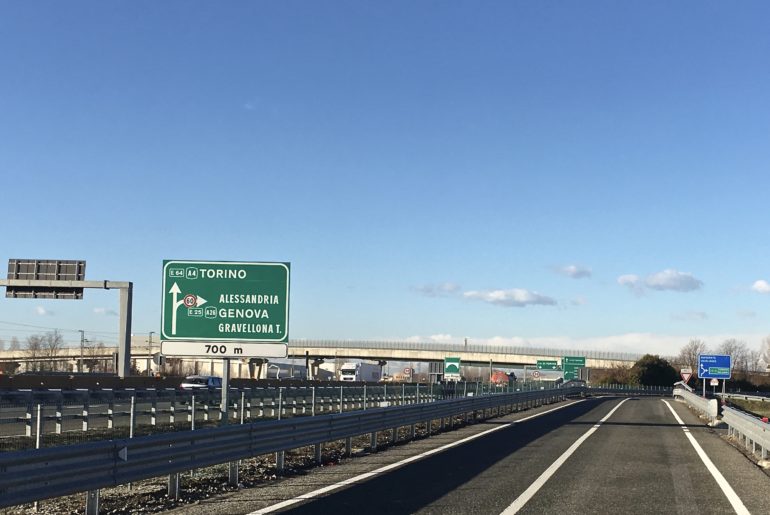
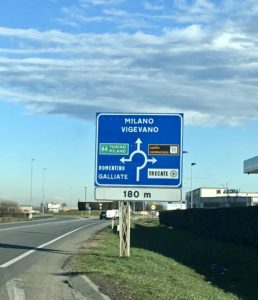
Easy direction signs
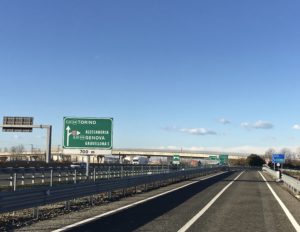
Firstly, all autostrade signs are always green, where as stradastatale (state or other roads) signs are in blue. The casello (or tollbooth) is the only place where you can enter the autostrada and exit. All exits are always to the right and well indicated. When you enter the autostrada you take a ticket- it’s not likely you can enter without taking one anyways, as the arm will not lift and let you continue- but what’s important is that once you do take the ticket, you don’t lose it. You will be fined heavily. Just look for a sign that says biglietto (ticket) and the drawing of a driver reaching for a ticket.
Push on the big red button and a ticket shoots out. Once you enter the freeway, it’s like entering a race track. However, the similarities end there. There is a speed limit of 130 km/hr. It’s less in the tunnels (110 km/hr) and less yet if there is construction. Drive at your own pace as long as you follow the rules of the land. Another great thing about the autostrada is the constant signage telling you how far the next stazione di servizio (gas station) is, as well as signposts pointing out point of interest such as an XI century castle or a XV century monastery, for instance. When the exit sign is posted, you usually have another sign that points out all the other destinations when taking that particular exit. That’s very handy, because often the place that you are going may be on that sign although the exit itself may not be called that..
Everything you Need in the Autostrada
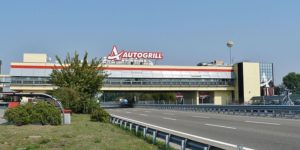
What’s great is that gas stations are just like a pits stop on a race track. Put your signal on, slowdown, stop at the pump, the attendees runs out fills the tank, you pay and you merge into traffic. It’s impossible to go in the wrong direction, unlike here in Canada and the states where you don’t have to leave the freeway and head out searching for a gas station. Incidentally, if you are using diesel, in Italy it’s called gasolio and gas is benzinaor senza piombo. The gasolio handle is yellow but sometimes blue. Benzina is always green. But wait… although the pit stop can be quick, the best part of the autostrada is the pit stop itself. In particular, the Autogrill. Some are so large that they sprawl over all six lanes of traffic.
Autogrill. Courtesy of Panoramio
Autogrill Driving Experience
Here you will find the opportunity to refill your stomach with great local foods, panini, pastries cappuccini and of course great local gastronomic gifts. Although Autogrill is a franchise and found all over the autostrada(e), they all have a distinct local feeling. For instance, if you’re driving through Emilia Romagna you will find Prosciutto diParma or Culatetto, as well as other typical foods the area. But if you are driving in the vicinity of Trento in the north you will find Speckor maybe Pancetta Stesa e Affumicataon their shelves. These Autogrill are sometimes so big that they straddle all six lanes of traffic, with sit down restaurants, self service buffets and/or quick service grab and go eateries. It’s unlikely that you wouldn’t find something to satisfy your appetite, even if you are not hungry.
A couple of rules to follow: the parking lot is an ideal place for individuals who prey on tourists and on cars full of luggage, so pay attention to your surroundings. I’ve stopped at Autogrill probably a thousand times and nothing has ever happened, but I still check my surroundings every time and hide things visible in the car. I know it’s common sense but nonetheless worth mentioning.
How the toll System Works
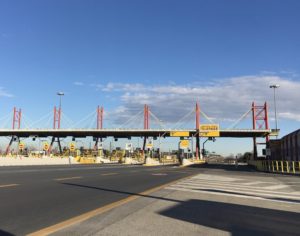
Toll booth before entering the autostrada
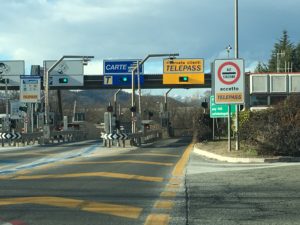
Exiting the freeway is quite simple. Look for signage above the tolls that say Viacard and/or Carte in blue (credit cards) or Telepass in yellow. Avoid the yellow painted lane directing you to the Telepass. That’s for those who have a device installed in their vehicles and are billed at home.
As a tourist, you likely have a car rental and won’t have that device. So avoid it and head for the one with Euro bills and coins on it if you are paying with cash or follow the blue painted lane with Viacardwhich accepts credit cards.
When you arrive at the booth, insert the ticket that was handed to you earlier, with the arrow pointing into the slot and then insert the credit card in the same slot. The machine will spit out your card so don’t panic. The bar will rise and a lovely voice will tell you “arrivederci.” If you want a receipt, press the button before inserting the card.
Pay at toll when exiting the highway.
Know When to Choose and Limit the Autostrada to Save When Driving
Using the autostrada is not inexpensive. Budget 10-15 cents per kilometre travelled. The time that you will save is irreplaceable. For instance, the threehour drive from Florence to Rome on the autostrada equals to 8 hours if you decide to take the free Via Cassia or SS2 as you go into every little town and village on the way. You will hit all the lights and stop signs, roundabouts as well as dealing with traffic in general. The surroundings may be spectacular and the scenery breathtaking but… it comes down to time and what is more important. That’s usually where I come in with options and recommendations with clients. Sort of choosing your battles. Maybe dividing up the trip between autostrada and the statale(country roads) based on what you want to see, where you need to be and how much time you have at your disposal.
Also important to know, on the autostrada the gas stations are open 24 hours and 7 days a week. But in the city or throughout the countryside, they open at 7am, usually close for lunch 12:30-3 or 3:30, and close again for the night at 7:30-8pm depending on the season and the area. Often they are closed on Sunday, so filling up on Saturday if you are planning a drive the next day is a good idea. There are automated gas stations, you just have to spend some time trying to figure them out.
Clear signs make driving easy in Italy
Excellent Signs and well Marked Directions
Although traffic signs are pretty well the same as rest of Europe and North America, one thing for sure is that you can not turn right on a red light. Since they drive on the right hand side of the road, it eliminates the worry of figuring out the traffic flow and direction.
Another interesting thing is that on the autostrada police will often have the Tutor Speed Control Systemset up to catch speeders, but they need to “advertise” that they are there. Often you’ll see electronic signs warning that “controllo di velocità” is active.( There will be a separate post on avoiding speed traps)
Polizia cars on duty always drive with their emergency lights on, so you can see them from a distance. It’s unlikely that they will pull you over. Usually they just pull up, enter your license plate in their system and move on. Tutor is the way they catch speeders. Also, as I mentioned earlier, tunnels have 110km/hr limits so those nice cameras often are set up just outside the mouth of the tunnel. Ideally you hit the brake just as you exit and you are good. Police will use the Tutor in the autostrade, and the autovelox system on all other roads. Just remember the speed limits and you are ok.
Stay in Your Lane and You’ll be Fine
Unlike North America, the lanes on the autostrada have minimum designated speeds. For instance, on a three lane the right lane is for busses, semis or any slow moving vehicle (maybe a motor home too). They can move to the center lane only to pass a slower car, but must return to the right lane right away. The middle lane is for anyone that is traveling at the speed of at least 90 km/hr up to 130 km/hr and the left lane is left for those that need to pass the middle commuters. DO NOT use a lane to the right to pass under any circumstance. The fines are high if not a complete license takeaway.
Headlights must always be on in the freeway and if it is raining heavy you should use the rear fog light. So as you read this, driving in Italy is not crazy at all. It’s simply a matter of getting used to their ways which are not so different from ours. For myself, I always rent cars when I arrive at airports,- make sure you have a international driver’s licence. You can easily purchase onet at any AAA or CAA agencies.
If you want to save money you can plan to rent cars only for the days that you must drive. Use the trains where it is most convenient. When I work with a client and we plan the trip, I always look at opportunities in minimizing the use of the car. Not so much because they are “crazy drivers” but because it can be expensive if not used wisely. Gasoline is expensive and also parking in major cities can be very expensive and hard to find. At the hotels downtown, I’ve seen parking as high as €50 per night so it would make sense to plan your car needs so as to avoid unnecessary expenses.
Are you travelling to Italy and are interested in my assistance, or would like to comment on my post? Just drop a line below or contact me privately at info@italiabound.com.
“We are going to be in Rome, on the Amalfi Coast, in Tuscany, and near Siena. What other interesting places are there to see?” This is one of the most asked question to me by friends or clients travelling to Italy.
That question carries a lot of weight. Italy is not a place that has a hundred interesting things to see nor a thousand. Italy may have its name to claim monuments, but the reality is that on your way from one monument to the next there may be 600 more interesting places and towns to see, and often more beautiful or interesting than what you were on your way to see originally.
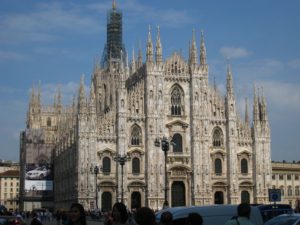
Milan’s Duomo
You could be in a small town station waiting for a train to Rome, for instance, and just by looking around you notice unique architectural delights.
Italy’s Cultural Pride
Italy and Italians over the century had and still do have lots of pride in their everyday work. The buildings were never built with only practicality in mind. They were built to reflect the culture, the people, therefore the times. Nothing says more about an architect, than the style of building that he or she builds. Fountains were designed with grandeur ideas and looks in mind. The “big square box” North American style buildings are never considered even in today’s Italy. Fortunately, laws are in place to prevent that. MilanoCentrale, as an example, was finished in 1931 by Mussolini. Its grandeur reflects his ego yet creates pride amongst Milanesi, even if most of them never were or no longer are fascists. It’s a mixture of Art Nouveau, Art Deco and fascism. Oh yes! and trains are supposed to stop there as well.
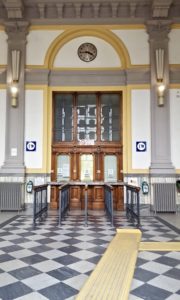
The marble floors and ticket wicket in Cuneo
Small Places as Interesting as…
Cuneo train station, to remain on the rail stations theme, is a beautiful architectural wonder that mesmerizes the average train user. It looks more like a museum. The restoration is meant to recreate what the original designers envisioned.
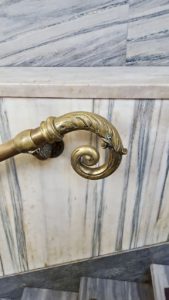
interesting details of the brass stairs handle by marble stairs
Cuneo is a town of just around 56,000 people nestled in the southwester area of Piemonte and hardly has the volume of tourists that Milan has. Nonetheless, when you come upon this town and its train station, you will be impressed.
To this day, Italians are leaders as they pour their pride in fashion, automotive, furniture design, and culinary delights, and that’s only the tip of the iceberg. This pride and artistic creativity is represented in everyday living. It makes for a more inspiring environment, therefore everyone benefits from. The way they dress, what they eat, how they socialize and how they live represent centuries of rich traditions, history and pride.
When asked “what else is there to see?”, the only answer that I can give is this: Keep your eyes, mind and senses always open and everywhere you go will never cease to amaze you. Italy is to tourists what a candy store is to a child.
Are you travelling to Italy and are interested in my assistance, or would like to comment on my post? Just drop a line below or contact me privately at info@italiabound.com.
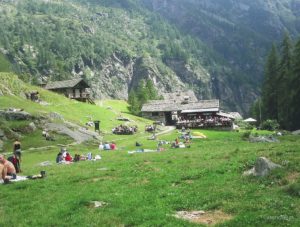
An easy hour-long hikethrough the Parco Naturale Alta Valsesia in the shadow of the Monte Rosa in Piemonte. Monte rosa is Italy’s second highest mountain, after Monte Bianco, in the Italian Alps. Here you criss-cross rivers and creeks on wooden bridges until you reach at 1575 metres in altitude the refuge. www.rifugimonterosa.it
Relaxing at the Rifugio Pastore
The hike stars in Wold, one kilometre passed the town of Alagna. You will continue for three kilometre or so on a paved road till Acqua Bianca. At this point you enter trail number 6 and head to the rifugio. There are two ways to get there, both start in Wold and both take the same amount of time. This one just happened to be my favorite.
The rifugio, isa rock and shale hut built in 1973 to commemorate an avid mountaineer Francesco Pastorewho had past away in an automobile accident. It’s purpose is to protect and give refuge to hikers and trekkers during storms, and rest for those continuing on. It’s also a restaurant and shelter for overnight guests.
Stay for lunch, or a merenda ( snack ). But whatever you decide, you must have their homemade cake (torta del rifugio) and a hot chocolate, Italian style. Well deserved treat for accomplishing the climb.
Pella to Santuario di Madonna del Sasso
Hike above the breathtaking Lago d’Orta. One and a half hours of easy strolling and hiking but once there, the view is magnificent. Visit the sanctuary before enjoying lunch at the Hotel Ristorante Panoramico. If you do, try the Strangozzi al Ragoût di Cinghiale (wild boar sauce). If the hike is too long, drive most of the way and maybe just walk the last 30 minutes from Artó. It certainly would give you a reason to work off the pasta.
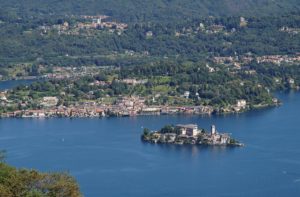
Later, drive back down to Orta, stroll the town and take the boat to l’Isola di San Giulio. Stroll the short pathway around the Benedictine monastery, pick up a souvenir and then have a cioccolata calda in PiazzaMotta back in Orta.
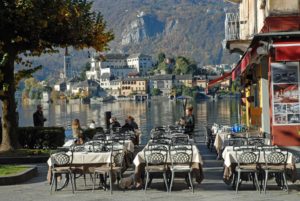
Piazza Motta in Orta with the Island of San Giulio in the bachground and the Sanctuary above and behind
An UNESCO Site
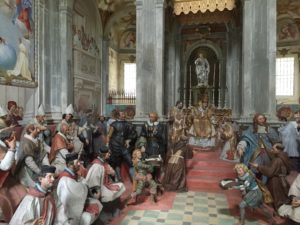
If you have the time, the Sacro Monte di Orta is a UNESCO site worth visiting. It’s only 5 minutes by car from any parking lot in Orta. A unique sanctuary with20 Franciscan chapels and 375 terracotta statues, depicting religious stories.
One of the 20 chapels with terracotta statues.
The construction started back in the late 1500’s and were terminated in 1788. The art work is remarkable and its also free. The whole site sits on top of the mountain with a gorgeous view of the lake. At the very least, if you running short of time you must try to make it back an other day. or do quick visit, it’s certainly worth strolling through. I have spent many of my visits to Italy discovering this beautiful small lake rich of secrets. I don’t know why, but I just love this lake in particular when it’s raining…call me crazy.
A hike on Lake Como
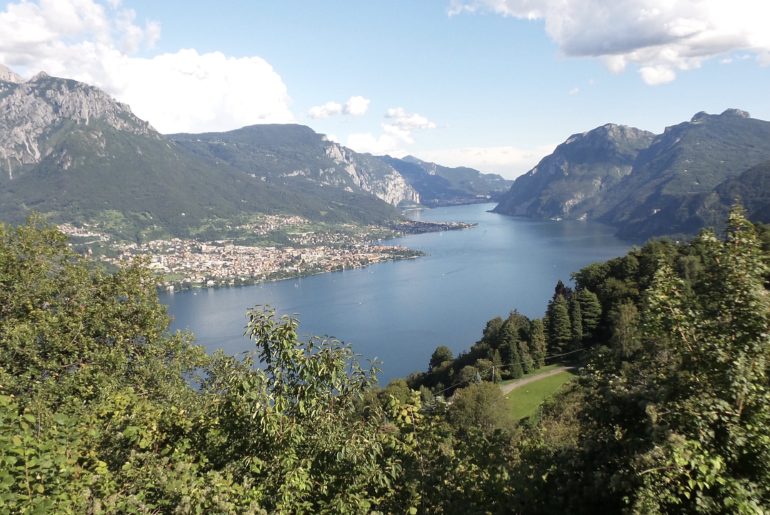
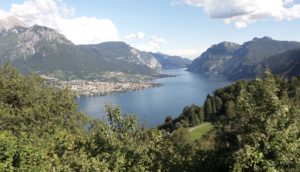
This is a longer hike but the terrain is plenty easy and the sights are amazing. You’ll need about three hours, but wow! it is certainly the most scenic of the lake of Como. Start the trek at the train station in Dervio. Why the train station? Simply because when you arrive in Bellano‘s train station you can catch any of the local trains back to your point of origin.
Leave Dervio station and head to the church of San Quirico e Giulitta facing the lake. Here is where the actual trail starts and although sometimes it’s paved, you are actually on ancient roads that were used to connect Como and Switzerland. Throughout the hike you will see ruins, mulattiere (mule trails) that date back centuries, and lots of farmland and farm houses, in particular the Cascine dei Ronchi, where you’ll have a marvellous view of the lake.
You’ll walk through the Valle deiMulini, cross over stone bridges and visit the Santuario diLezzeno and the church of San Bernardino or the one of San Rocco.
This trail is a wonderful testament to history and earlier civilizations. You will reach the Orrodo gorge, an amazing natural wonder with suggestive waterfalls and gollies. Soon after that you’ll see the church of theSaintsNazaro e Celso before heading to Bellano where the trail actually ends at the train station.
Easy Train Ride Home
Relax a bit, have a cappuccino or lunch pending what time you get there and afterwards take the easy way back to Dervio. Since the train ride is only 6 minutes, yes 6 minutes, and costs about €1,50, you can spend some time just visiting that town.
If you don’t want to hike the total distance, and since the two towns are only six minutes by train, you could hike a few kilometres in each place. You will get a good feeling about the area and still see some great panoramas, and at the same time you have given yourself a good pat on the back for having done at least somewhat of a good nature walk. Any amount of time amongst nature is time well spent. Good for the body, the spirit… and the appetite.
“Till then…Buon viaggio
Are you travelling to Italy and are interested in my assistance, or would like to comment on my post? Just drop a line below or contact me privately at info@italiabound.com.
I thought I would start a blog about travel. Not so much because I do a lot of travelling but because I’m constantly asked by clients, friends and acquaintances questions about traveling in Italy. I figured, if all these people are constantly asking for help and advice, there must be many more out there that could use the same.
Italy Should not be Cookie Cutter Holiday
There are a lot of travel agents out there and many more websites, and travel bloggers that do a great job telling you what to do, where to go. Often they target the masses, and if everyone does the same thing, well, you hardly will do anything unique or different. Fortunately for me…and for you I bring a different angle that focus on the topic but comes from an insider’s point of view. I lived in Italy, travel often there, speak several of its dialects and am passionate about my homeland.
Unique Personal Experience
I like to think of myself as more of an insider with valuable information rather than a travel savvy person or agent. The people that I’ve helped over the years always seem to be looking for the same information. Yet have different interests and tastes. They want to know where to find the things they need and what to do that is out of the ordinary. I realize that helping my clients not only saves them money but more importantly saves them time. This allows them to enjoy new things that were not in their original plans. It also puts them at ease about where they are going and the uncertainties are alleviated if not completely eliminated.
Diversify Your Visit in Italy
Although I’ve traveled alone as well as with my family all over Europe, Canada, US and Japan, I give my advice only about my homeland, Italy, because I know it well. I no longer live there, but did grow up in Novara in the Piemonte region and traveled intensely throughout it as well into Friuli where my grandmother lived until she was 99 years old. I would never miss visiting that beautiful region and its hidden treasures.
We also skied in Val D’Aosta and sunbathed in Liguria and Tuscany, so all of Northern Italy in particular is like my own backyard. I lived it and loved it as a child, teen and young adult and enjoy bringing my family there as well. All three of my children and my wife (who doesn’t have an Italian background) have been there many times.
Holiday Like Italians Live
What makes these regions so wonderful is the simplicity of how people live and enjoy life to the fullest. It’s how in Novara at ten o’clock at night, we meet friends in the piazza for a gelato or drive 60 kilometres to Monferrato to have a fabulous lunch that takes three or four hours to consume. And, while we eat the children play outside in the gardens. You can’t go more then 10 kilometres without experiencing a new site, whether it’s monasteries, churches, castles, villages on the many picturesque lakes such as Orta, or ferrying off to an island on the Lago Maggiore.
You can travel from Novara to Udine, for instance, and experience completely different sceneries. Here the dialect, which I know, is a mix of Slav, Italian and Austrian. The piazza has the same architectural designs as Venice, although there is no water to be found. Udine was once part of the Serenissima, The Venetian Republic. Do you want great wine. Great food. Friendly people. Breathtaking panoramas, mountains or white sandy beaches,? Then it’s all in one package in Friuli region.
All these regions offer everything a traveler would want for a complete Italian experience. Different from many other touristy areas, in Friuli you will experience and live more like the Italian way. Foreign tourists are scarce and few. I like to promote more areas such as these because in many ways they reflect more of the true Italian lifestyle. Often these areas are overlooked and not incorporated in travel plans.
Expand Your Horizons and Explore Italy Landscapes
Individuals that spend their money traveling often want to go where they know they won’t be disappointed. In doing so, they often miss great opportunities to experience new sites. Not everyone is a Lonely Planet type of traveller. Sometimes if an individual only travels once a year for three weeks, they want the best bang for their buck. And who can blame them. Traveling these days can be expensive and time consuming. Why then waste time figuring out what to do once you have already landed. Planning is essential, but at the same time one must leave something for the unexpected.
So, join me in the blogs to come as I explore Italy and give some insights about places, people, food and culture, and I’ll help you discover places that you should visit but often wouldn’t have otherwise considered or better, never even knew existed.
“Till then… Buon viaggio.
Are you travelling to Italy and are interested in my assistance, or would like to comment on my post? Just drop a line below or contact me privately at info@italiabound.com.